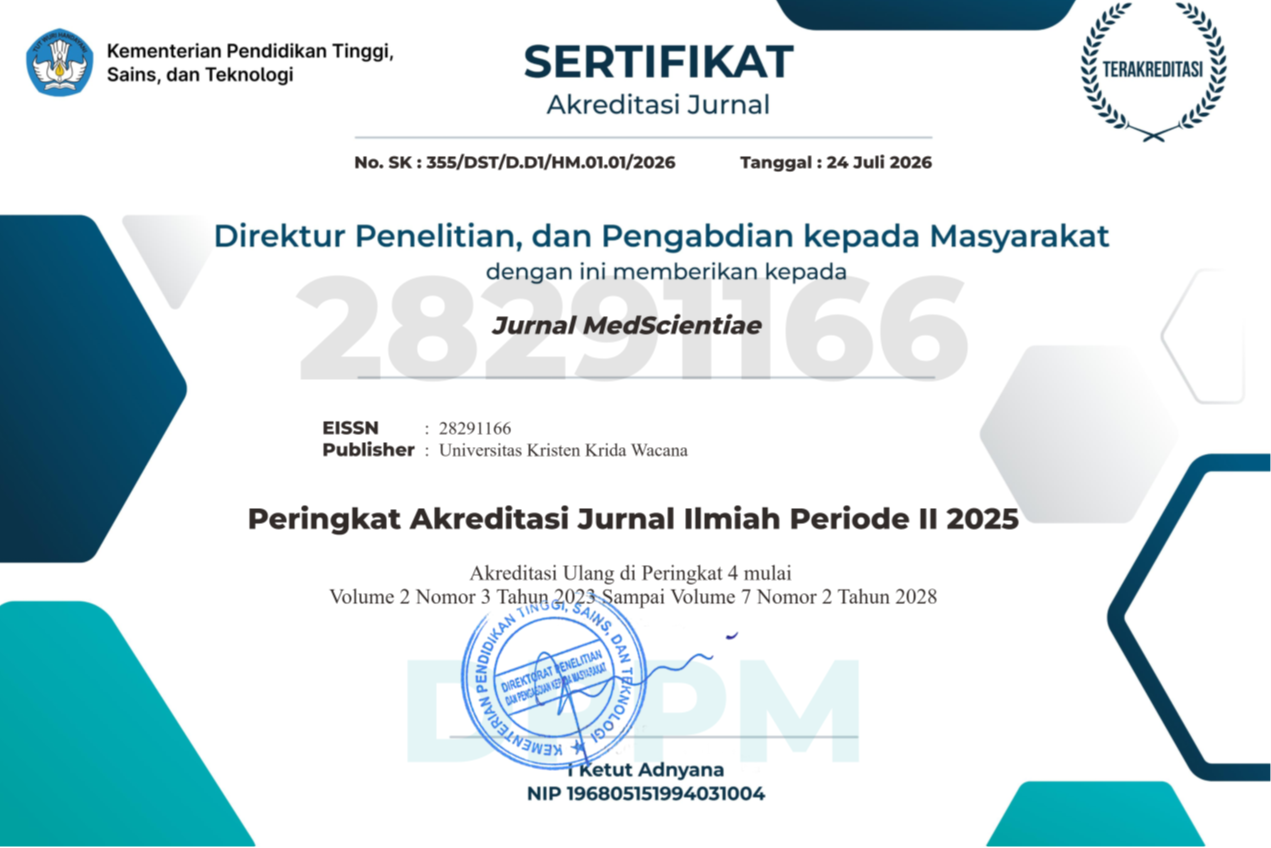
ISSN : 2829-1166

Manuscripts submitted must be written in Indonesian, and the abstract must be provided in both Indonesian and English. Manuscripts submitted for publication will be reviewed by one independent reviewer, and if necessary, revisions must be resubmitted by the author. Manuscripts that do not comply with the standard requirements of MedScientiae Journal will be returned to the authors for correction within the time limit specified by the Editorial Team.
Corrections or suggestions from reviewers for each manuscript will be sent to the authors before the manuscript is accepted/approved for publication. The final revised manuscript must be returned along with the reviewer’s comments. Several revisions are usually required after the review process, and final acceptance generally depends on the outcome of the revisions.
When submitting a revised manuscript, authors are requested to provide an explanation of how the revisions were made and the reasons for not accepting reviewer corrections or suggestions that have not been revised. A manuscript will be considered withdrawn if the author does not respond within a maximum of three months after the review results are provided. The corresponding author will be notified of the editor’s final decision via email.
________________________________________
Manuscript Acceptance Procedure
Accepted manuscripts must be submitted online through the Open Journal System (OJS) of MedScientiae Journal in Microsoft Word format.
________________________________________
Manuscript Submission
The journal only accepts online submissions, through the Open Journal System and via email to the managing editor at:
___________________
Manuscripts must be submitted along with a completed submission form available on the journal website.
Submitted manuscripts must not have been previously published and must not be under consideration for publication elsewhere. When a manuscript is written by a group, all authors must read and approve the final version of the submitted manuscript and its revisions, and agree to submit the manuscript to this journal.
All authors must make substantial contributions to:
the concept and design of the research
data acquisition and analysis
manuscript preparation and revision
All authors are responsible for the quality, accuracy, and ethical integrity of their work.
________________________________________
Preparing the Manuscript
Before submitting the manuscript, please ensure that:
The manuscript has been carefully proofread several times by the author and co-authors.
The language has been edited by a professional scientific editor or a native English speaker.
The manuscript structure follows the journal guidelines (sections, references, figure quality, etc.).
The abstract provides a clear overview of the paper and attracts potential readers.
The number of references cited is within the journal limit (approximately 20 for research articles and 30 for review articles).
The abstract must be written in clear and grammatically correct Indonesian and English.
Manuscripts written in Indonesian should be concise, with an abstract of approximately 200 words.
Original research articles: maximum 8,000 words (including tables and figures).
Review articles: accepted by the journal.
Short communications: approximately 2,000 words.
For research papers, the manuscript must be organized in the following order:
Title
Abstract
Keywords (arranged alphabetically from A–Z)
Running Title (Heading)
Introduction
Materials and Methods
Results and Discussion
Conclusion
Acknowledgements (if necessary)
References
For review articles and short communications, the structure may be adjusted accordingly.
________________________________________
Manuscript Format
Manuscripts must be typed on A4 paper (210 × 297 mm) in single column, single spacing, using Times New Roman 11 pt.
Margins:
Top: 3 cm
Bottom: 2 cm
Left: 1.8 cm
Right: 1.8 cm
Smaller font sizes (10 pt) may be used in tables and figures.
The manuscript should be prepared using Microsoft Word-compatible software with file format .doc or .rtf (not .docx).
Scientific names of species (including subspecies, varieties, etc.) must be italicized, except when already in italic sentences.
Scientific names (genus, species, author) and cultivar or strain names must be written in full the first time they appear in the text, especially for taxonomic manuscripts. The genus name may be abbreviated after the first mention unless it causes confusion.
Example:
Rhizopus oryzae L. UICC 524 may subsequently be written as R. oryzae UICC 524.
The use of common names should be avoided if they may cause confusion.
Biochemical and chemical nomenclature should follow IUPAC–IUB conventions.
Metric measurements must use SI units, and other systems should include their SI equivalents.
Abbreviations such as g, mg, mL should not be followed by periods.
Mathematical equations may be written separately if they cannot be placed in a single column.
Numbers one to ten should be written in words unless related to measurements; numbers above ten should be written in numerals, except at the beginning of a sentence.
Fractions must be expressed in decimals. In text, use “%” instead of “percent.”
Avoid complex and lengthy sentences, and use clear, efficient, and effective wording.
________________________________________
Title
The title should be concise, clear, and informative, preferably no more than 14 words.
Author names must be written in full, including first and last names. Institutional names and addresses must be written completely, including street name and number, postal code, telephone number, fax number, and email address.
Local Indonesian names should be used for universities in Indonesia.
If the manuscript is written by a group, a corresponding author and email address must be provided (indicated by “*”).
The title page (first page) must contain:
Article title
Full author names
Institutional affiliations
Author addresses
Corresponding author email
________________________________________
Abstract
A concise abstract (approximately 200 words) is required.
The abstract must be informative and briefly state:
the research objective
the main results
the main conclusions
Abbreviations should be avoided unless essential; if used, they must be defined at their first appearance.
________________________________________
Keywords
Keywords consist of a maximum of five words, including:
scientific names and local names (if applicable)
research themes
specific methods used
Keywords must be arranged alphabetically (A–Z).
________________________________________
Abbreviations
All important abbreviations must be defined at their first occurrence. Ensure consistency throughout the manuscript.
________________________________________
Introduction
The Introduction should be approximately 400–600 words, including the research objective and sufficient background information, while avoiding detailed literature surveys or summaries of results.
________________________________________
Materials and Methods
This section should emphasize the procedures and data analysis methods used in the study.
________________________________________
Results and Discussion
Results and discussion should be written as a connected narrative, but manuscripts with lengthy discussions may be divided into subheadings.
The discussion should explain cause-and-effect relationships, particularly why and how the research results occurred, rather than merely restating the results.
________________________________________
Conclusion
The Conclusion must be provided at the end of the discussion.
________________________________________
Figures and Tables
Figures and tables should not exceed three pages and must be clearly presented.
Figure captions should be written below the figures.
Table titles should be written above the tables.
Graphs should preferably be presented in black and white.
All figures belonging to other authors must obtain permission from the original source.
________________________________________
References
References must follow the Vancouver citation style. The cited references should preferably be within the last 10 years.
Journal Article Example
Alexander, Sari MP, Susilowati RP. Insektisida nabati dalam bentuk aerosol terhadap mortalitas Aedes aegypti. Jurnal Kedokteran Meditek. 2022;28(2):50–60.
Use “et al.” when the number of authors exceeds two.
Book Example
Susilowati RP.Mendelian Genetics: inheritance and deviations. Purwokerto: Pena Persada. 671 p.
Conference Proceedings Example
Susilowati RP, Sari MP. Neurotoxic effects of transfluthrin, d-allethrin, and permot leaf extract (Passiflora foetida) on the German cockroach (Blattella germanica). Proceedings of the National Seminar on Medical Research (SENSORIK II), Universitas Veteran Jakarta, February 8, 2021.
Thesis / Dissertation Example
Jefferson R, Susilowati RP, Sari MP.Potassium content of bananas in Indonesia and its levels in blood serum.Undergraduate Thesis. Jakarta: Krida Wacana Christian University. 2022.
Online Document Example
Ministry of Health of the Republic of Indonesia.Indonesia Health Data Profile 2011.[Internet]. [cited November 20, 2021].Available from: http://www.depkes.go.id/
Jurnal MedScientiae © 2022 by Krida Wacana Christian University is licensed under Creative Commons Attribution-NonCommercial-ShareAlike 4.0 International